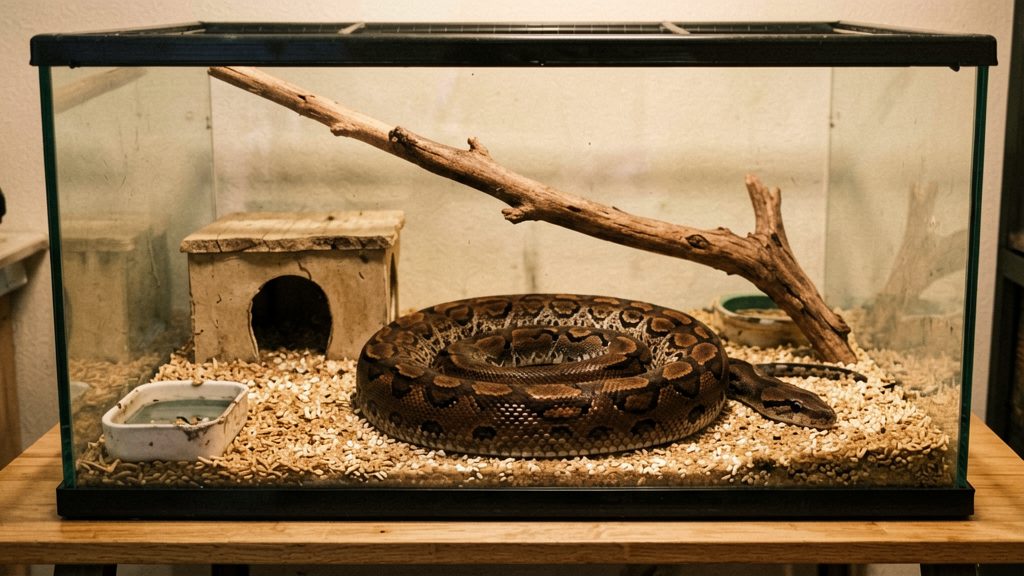
For an adult ball python, start your search with an enclosure measuring about 4 × 2 × 2 ft or larger, in length × front-to-back depth × height. That is the recommendation from the Humane Society of Kitchener Waterloo & Stratford Perth. Treat it as a starting point for shopping: the final choice must accommodate your particular adult, its furnishings and the equipment needed to maintain suitable conditions in your home.
How do you choose dimensions for your particular adult?
Measure the snake before ordering its permanent enclosure. A practical approach is to photograph it beside a known reference while it moves naturally across a level surface. Keep the camera perpendicular to the surface to reduce perspective distortion. Wait for a relaxed, extended posture; never pull the snake straight or restrain it to obtain a measurement. Repeat the observation if the first estimate is uncertain.
The UK animal-welfare charity RSPCA recommends enough enclosure length for full extension, with width and height each at least one-third of the snake’s length. Its example is:
| Snake length | Enclosure length | Front-to-back depth | Height |
|---|---|---|---|
| 120 cm | At least 120 cm | At least 40 cm | At least 40 cm |
This British welfare recommendation uses a different proportion from the Canadian recommendation above. They should not be presented as an identical minimum.
Ask the seller for internal dimensions. Wall thickness, backgrounds and built-in equipment can reduce the usable interior. Check the order of measurements, too: a listing may use width × depth × height, with “width” describing the long front face. Request a dimensioned drawing whenever the listing is ambiguous.
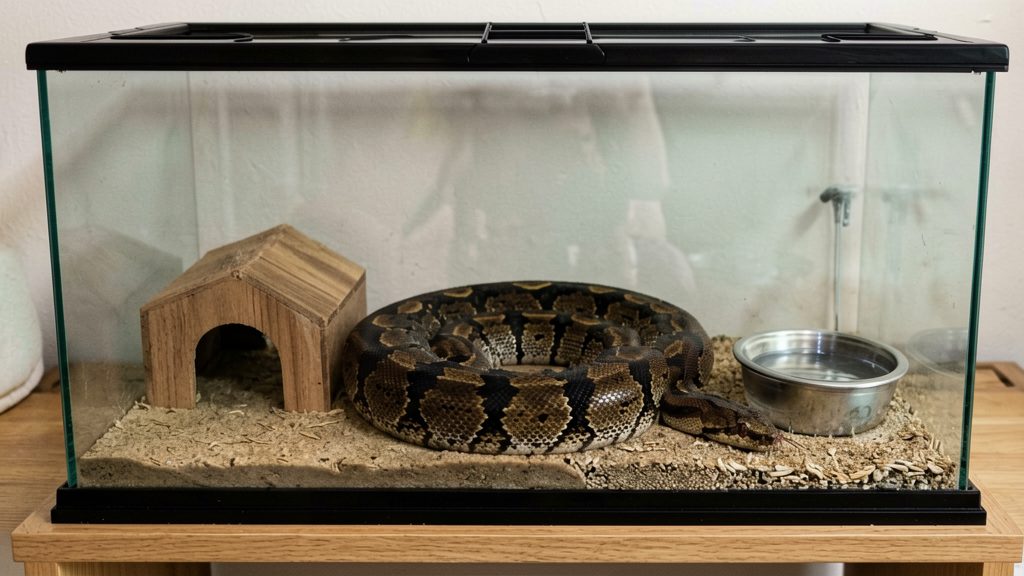
Why is a 40-gallon label an unreliable buying guide?
A gallon rating describes volume, while an enclosure’s shape determines how that volume is distributed. A tall, narrow tank and a long, shallow tank can offer very different living space. Compare the actual dimensions with your housing plan before deciding whether an existing aquarium is suitable.
For a tank you already own, record:
- Its clear internal length and front-to-back depth.
- The available height after adding substrate and equipment.
- Whether a secure reptile lid or door system is available for that exact tank.
- How heating and lighting can be mounted according to their instructions.
Also check the intended life stage on starter-kit documentation. A manufacturer’s snake starter-kit housing instructions explicitly identify the included terrarium as suitable for juvenile ball pythons. A ball-python image or a general “snake kit” description therefore needs closer reading before purchase.
How should you plan the furnishings before buying?
Draw the enclosure footprint on paper and add the actual outlines of the equipment you intend to use. Include entrances and access routes, rather than representing every furnishing as a small symbol. This reveals whether the proposed layout will work once assembled.
Fit the hiding spaces to the snake
Provide snug hides at the warm and cool ends, with cover between them. According to the RSPCA, a coiled python should fit inside its hide while being able to touch the interior. Large, exposed spaces need plentiful cover.
Use the hide’s internal cavity dimensions when checking fit. A wide decorative base can occupy substantial floor space while offering a surprisingly small shelter. Position entrances so the snake can enter without squeezing between rigid objects.
Reserve room for water and exploration
The Canadian humane society’s housing guidance includes a shallow water dish large enough to accommodate the snake’s whole body, along with terrain for climbing and exploration.
Choose the bowl before finalizing the layout, and make sure it can be lifted out without dismantling the habitat. Anchor climbing supports so they cannot roll or tip under the adult’s weight. Check the space beneath and behind them for trapping points, especially where branches meet backgrounds or fixed panels.
Should you choose glass or PVC?
Compare the complete construction rather than choosing by wall material alone. The Canadian humane society identifies aquariums and custom PVC or melamine enclosures as housing options. Each prospective enclosure still needs an assessment of its roof, vents, joints and equipment fittings.
| Construction detail | What to check before ordering |
|---|---|
| Glass enclosure | Examine the lid attachment, panel joints and provision for safely mounting equipment. |
| PVC enclosure | Confirm roof construction, ventilation openings and approved fixing points for fixtures. |
| Panel-built enclosure | Ask how joints and exposed edges should be protected from moisture. |
| Flat-pack enclosure | Read assembly instructions and confirm whether sealing or curing is required before use. |
PVC does not automatically mean a solid roof: manufacturer construction documentation shows that PVC designs can include full mesh tops. Roof design therefore belongs in your comparison.
For a Canadian home, describe the intended room to the supplier, including its coldest overnight conditions and any seasonal changes you have measured. Ask whether the proposed enclosure and equipment combination can maintain the required environment there. Avoid selecting heating equipment solely from an enclosure’s advertised size.
How do dimensions affect heating and lighting safety?
Plan a heated end and a cooler end so the snake can choose its temperature. The RSPCA gives a basking-zone target of 30–32°C and a cool-end target of 24–26°C. These describe different locations, rather than an enclosure-wide temperature.
Select a thermostat compatible with the chosen heater. A dimming controller varies the power supplied to a compatible heat source, as explained in the thermostat manufacturer’s technical description. Check the exact model’s electrical rating, permitted heater types and installation instructions for the equipment sold in Canada.
Allow space for the fixture, its protective guard and the manufacturer’s required clearance from accessible surfaces. Measure that clearance from the highest place the snake can reach, including raised furnishings. Adding a climbing branch later can change the safety of an otherwise acceptable installation.
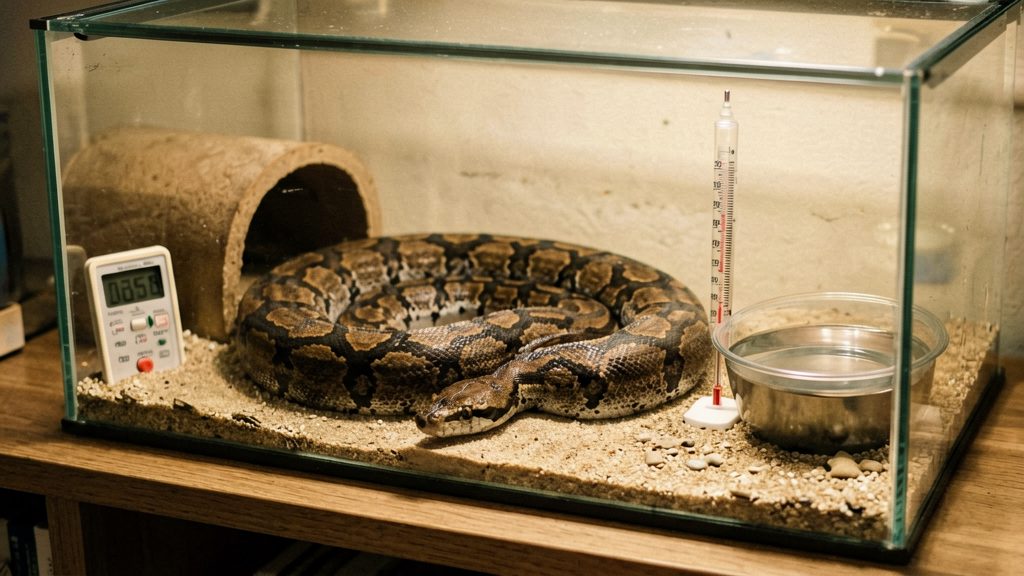
A thermostat controls heat output; a separate thermometer checks the resulting temperature. Heat-source technical guidance also recommends independent temperature verification. Use an infrared thermometer for surface checks and an appropriate probe thermometer for air measurements; keep those readings clearly distinguished in your records.
If fitting UVB, follow the exact lamp’s mounting and distance instructions, including guidance for any intervening mesh. Establish suitable exposure and access to shade before deciding where elevated furnishings will go.
How can you assess humidity without sacrificing ventilation?
Include humidity management in the enclosure plan rather than trying to solve it after the snake moves in. The Canadian humane society recommends moisture-retaining substrate and a hygrometer for monitoring conditions.
Before buying, ask how the enclosure is intended to be ventilated and whether the manufacturer permits any adjustments. Keep ventilation openings accessible for inspection. Follow the substrate manufacturer’s preparation instructions, and check whether the enclosure base is designed to contain damp substrate without leaking.
Record humidity alongside temperature, identifying where the sensor sits. Readings from different locations are easier to interpret when their positions are documented. Recheck conditions when household heating or air conditioning changes. Condensation on a panel is an observation to investigate, rather than a substitute for a humidity reading.
What installation and cleaning access will you need?
Check the delivery route as carefully as the final position. Measure doorways, stair turns and the space needed to assemble the enclosure. Confirm that the stand supports the enclosure as its manufacturer requires, including the anticipated weight of substrate, water and furnishings.
At the installation site, check practical access:
- Can the doors open fully without striking nearby furniture?
- Can you reach the back corners without leaning on fragile fittings?
- Can fixtures be serviced without moving the occupied enclosure?
- Can electrical connections remain outside splash-prone areas?
- Can you remove contaminated substrate without carrying it through food-preparation areas?
Choose a maintenance arrangement that makes hygiene straightforward. The Public Health Agency of Canada (2022) explains that reptiles can contaminate their enclosures with Salmonella. It recommends cleaning equipment outdoors whenever possible and washing hands after contact with reptiles or their surroundings.
Keep dedicated cleaning containers and tools readily available. Follow the enclosure manufacturer’s restrictions on cleaning products, and the disinfectant label’s dilution, contact-time and rinsing directions. Plan where the snake will remain securely contained during a full clean, including while surfaces dry and the habitat is reassembled.
When is the new enclosure ready for your snake?
Commission the enclosure in its final location with the substrate, furnishings and equipment installed. The RSPCA recommends running a new setup for a week before introducing the snake.
Use that trial to check conditions through the programmed daytime and night-time settings. Record readings and sensor locations so you can distinguish an equipment adjustment from a change in measurement position. Confirm that cables are routed through their intended openings and that closures engage properly after routine access.
If a reading falls outside your chosen care targets, correct the installation and repeat the relevant checks before transferring the animal. Follow equipment instructions when adjusting settings or repositioning sensors. Finish by recording the working configuration, including fixture positions and controller settings, so future maintenance can restore the arrangement accurately.
Frequently asked questions
Can adult ball pythons share an enclosure?
Plan separate housing. The manufacturer’s snake housing guidance recommends keeping ball pythons individually to avoid stress or feeding refusal. Increasing enclosure size does not change that recommendation. Housing guidance.
Does an adult need a separate feeding enclosure?
A separate feeding tank is unnecessary for routine feeding. The RSPCA recommends offering frozen-thawed prey inside the snake’s vivarium using feeding tongs. RSPCA feeding guidance.
Can adult enclosures be stacked?
Only use an arrangement approved for the exact enclosure. Check the manufacturer’s required support hardware and assembly instructions; purpose-made stacking components are specific to compatible designs. Manufacturer stacking documentation.