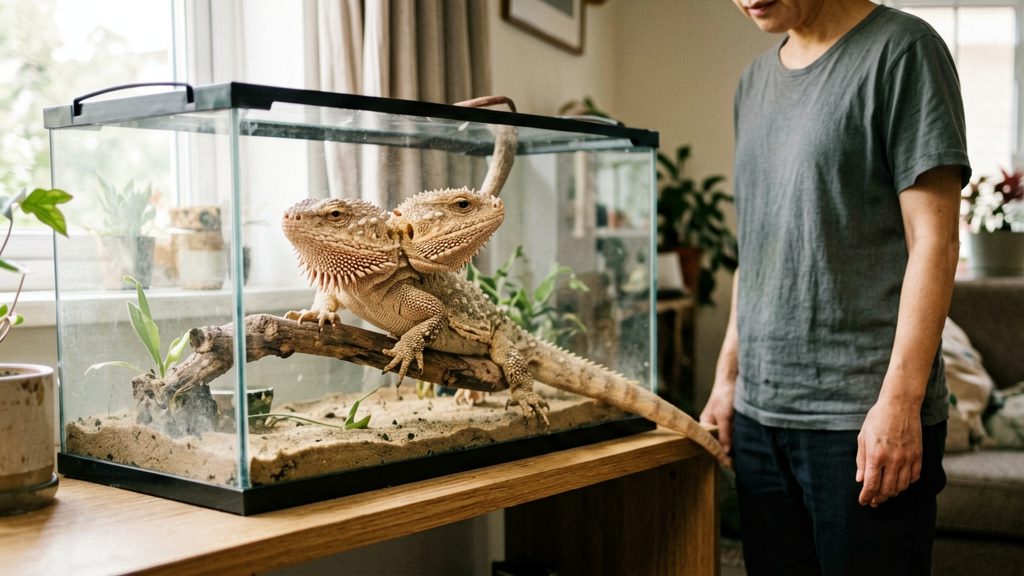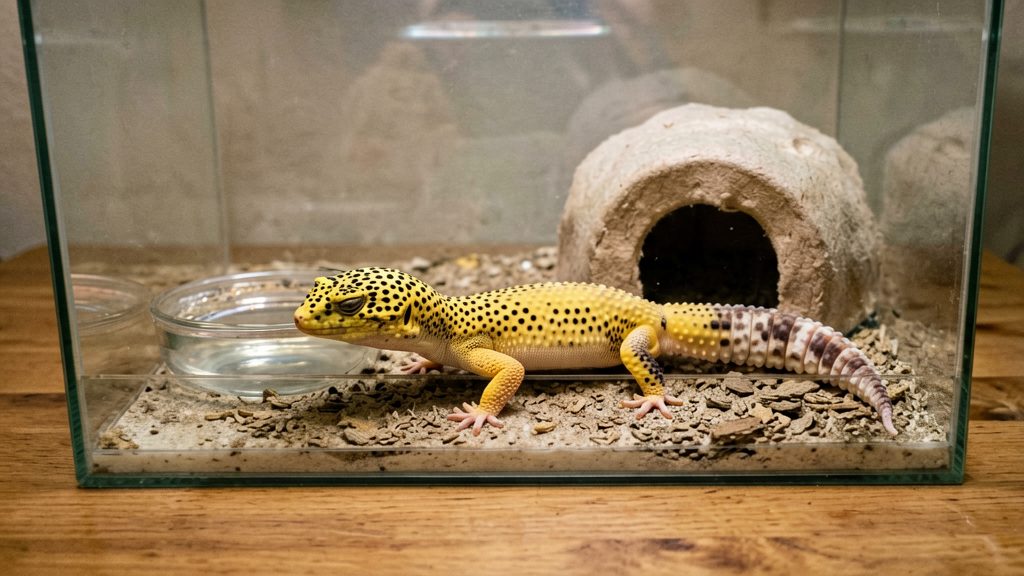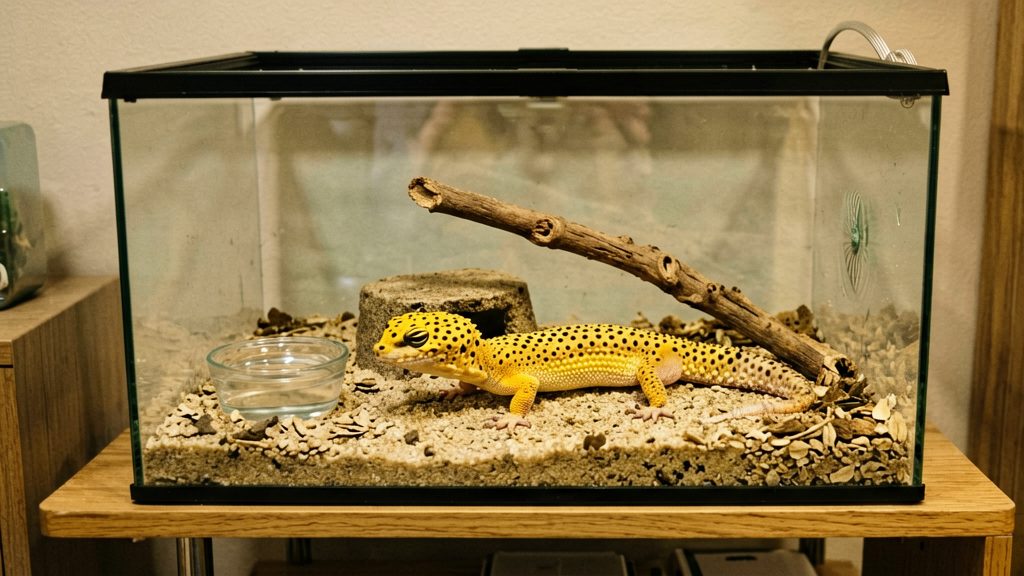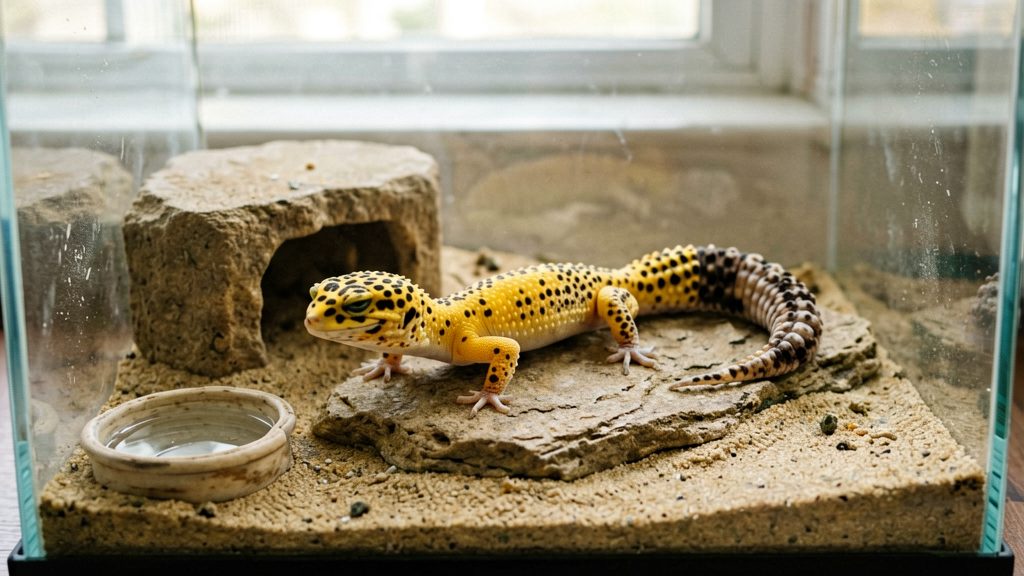
For first-time owners, leopard gecko care starts with preparing a complete habitat before bringing the animal home. Plan around a 36 × 18 × 18-inch enclosure for a single adult, following Ontario Reptile Rescue’s husbandry recommendation. This is a practical starting size, rather than a universal minimum shared by every care guide. The setup must accommodate distinct environmental zones and room to explore. Ontario Reptile Rescue
How should you choose and arrange the enclosure?
Prioritize usable floor space. A tall, narrow enclosure cannot provide the same ground-level layout as a longer habitat. Before buying, mark out the actual footprint of the hides, water dish, and furnishings so you can see whether open routes remain between them.
Choose secure doors or a locking lid, ventilation, and surfaces you can reach for maintenance. Front-opening access makes routine work easier without reaching down over the animal. House leopard geckos individually: competition and aggression can cause injuries even when animals previously appeared compatible. Ontario Reptile Rescue
Keep the enclosure out of direct sunlight. Sun through a window can overheat a terrarium regardless of how carefully its electric heating is controlled. Manufacturer’s habitat guidance
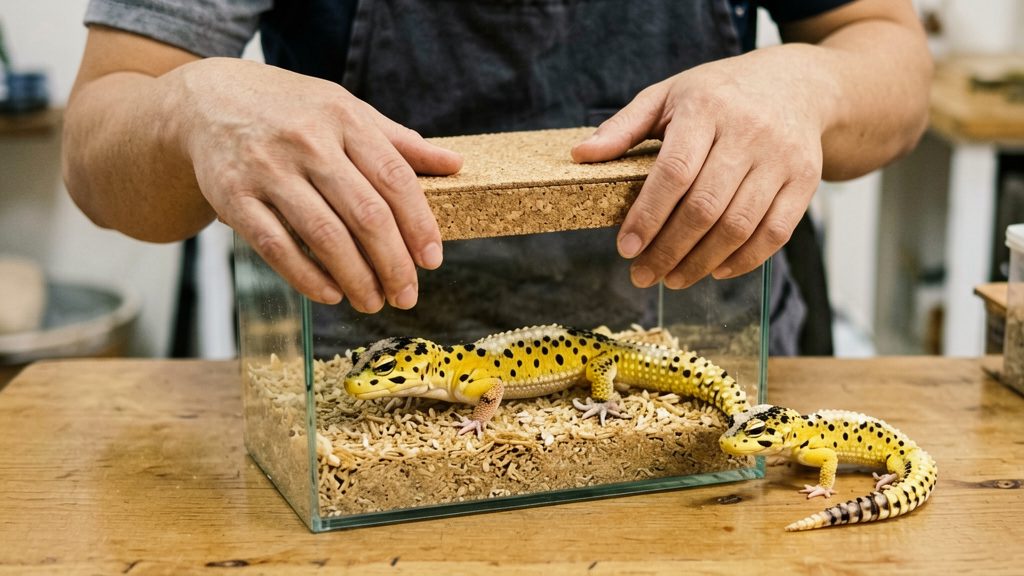
Which hides and flooring make daily care manageable?
Provide retreats with different functions:
| Retreat | Purpose | Practical setup |
|---|---|---|
| Warm hide | Shelter within the heated area | Position it where the gecko can warm up while concealed |
| Cool hide | Shelter away from the heat source | Keep it at the opposite end |
| Humid hide | Access to a moist microclimate | Use an enclosed hide with an appropriate damp lining |
BeWild Reptile Rescue recommends this arrangement and identifies paper towels or tile as beginner-friendly flooring options. Paper towels make droppings and contamination easy to see. Textured tile offers a reusable surface, provided the pieces sit securely without hazardous gaps. BeWild Reptile Rescue
Loose, soil-like substrates can support a more naturalistic enclosure, but their suitability depends on the animal’s health and the rest of its husbandry. Establish feeding and environmental control before making that change. Avoid choosing a substrate solely because its packaging shows a desert animal.
Add low, stable branches or other furnishings that encourage exploration. Check for sharp edges, unstable pieces, and openings that could trap the gecko. Phoenix Herpetological Society
How do you manage heating safely?
Put the heating equipment at one end so the gecko can move between warmer and cooler conditions. Heating the entire floor or enclosure evenly removes that choice.
A manufacturer’s leopard gecko guide lists these reference temperatures:
| Location or period named in the guide | Reference temperature |
|---|---|
| Daytime terrarium temperature | 78–85°F |
| Basking spot | 90°F |
| Nighttime temperature | 70–72°F |
These values describe different conditions; they are not interchangeable thermostat settings. In particular, a basking spot reading does not describe the temperature throughout the habitat. Manufacturer’s species guidance
Separate measurement from control
A thermostat adjusts the heater. An independent thermometer checks what the enclosure actually reaches. Use probe thermometers to follow temperatures at relevant locations, and an infrared thermometer to inspect accessible surfaces. An infrared device measures surface temperature, so it cannot replace an air-temperature reading. Manufacturer’s thermostat instructions
Choose a controller compatible with the heater. Dimmable heat lamps require suitable dimming control; other heating equipment may require a different operating mode. Check the controller’s supported equipment and electrical rating before connecting anything.
Follow that controller’s instructions for probe placement. A probe exposed directly to radiant heat may behave differently from a shaded probe, and moving it changes the control system. Secure it against displacement, then verify the resulting temperatures independently. Test the completed arrangement through its daytime and nighttime operation before introducing the animal. Manufacturer’s thermostat instructions
Avoid heated rocks: their contact surfaces can cause burns. Veterinary husbandry guidance
How should you select UVB lighting?
Choose UVB equipment intended for shade-dwelling or crepuscular reptiles, with installation guidance suitable for leopard geckos. A lamp’s advertised UVB percentage does not tell you the exposure reaching the animal.
Before installing it, check:
- The recommended distance for the exact lamp and fixture combination.
- Whether the manufacturer’s measurements include a mesh screen.
- The position of the highest surface the gecko can reach.
- The availability of fully shaded retreats.
Manufacturer documentation demonstrates that exposure changes with distance and that mesh reduces UV transmission. Use the appropriate installation chart rather than copying the distance from another keeper’s enclosure. Where available, a suitable UV Index meter lets you check exposure at the animal’s position. Manufacturer’s UVB installation guidance
For an albino or unusually light-sensitive gecko, have a reptile veterinarian help assess the lighting arrangement. BeWild Reptile Rescue
How do you balance humidity and ventilation?
Phoenix Herpetological Society recommends ambient humidity around 30–40%, alongside a separate moist retreat. Measure humidity with a hygrometer instead of judging it by how dry the enclosure looks. Phoenix Herpetological Society
Keep the humid hide’s lining damp and inspect it regularly. Replace it if contaminated, and adjust moisture when it dries out. An enclosed, localized humid area allows the gecko to choose that condition without making the entire habitat wet. Veterinary husbandry guidance
What should you feed, and how should you use supplements?
Build meals around a variety of appropriately sized feeder insects. Crickets, mealworms, and other suitable cultured feeders provide different options; a single insect type should not become the permanent menu. Choose manageable prey rather than the largest insects available. Remove uneaten crickets after feeding. Keep fresh drinking water available in a clean dish. Manufacturer’s feeding guidance
Maintain the feeders as well as the gecko
Gut-loading means feeding the insects nutritious food before offering them to your reptile. Follow the feeder diet’s directions, and maintain the insects in a suitable ventilated container. Neglected feeders are a poor foundation for a feeding routine. BeWild Reptile Rescue
Phoenix Herpetological Society uses daily feeding for juveniles and every-other-day feeding for adults as general guidance. Treat that as a starting schedule: portion size and frequency need adjustment for growth, body condition, and the individual animal. Record meals so another caregiver can follow the same plan. Phoenix Herpetological Society
Coordinate calcium, vitamins, and UVB
Use reptile-appropriate calcium and vitamin supplements according to their directions. Dusting means coating feeder insects with the powder before offering them. Do not combine several overlapping products without checking their ingredients and schedules. Manufacturer’s nutrition guidance
Vitamin D supplementation must account for the UVB setup. Keep a written record of which supplement accompanies each feeding, and ask a reptile veterinarian to review an unclear combination. More powder is not automatically better. BeWild Reptile Rescue
When can you begin handling your gecko?
Allow the newcomer to settle before starting recreational handling. Phoenix Herpetological Society recommends an acclimation period of approximately 1–2 weeks. During that period, keep necessary care calm and predictable, and observe how the animal responds to its surroundings. Phoenix Herpetological Society
When you begin, gently scoop the gecko from underneath and support its body and feet. Keep it close to a secure surface. Never catch, lift, or restrain it by the tail, which it can detach under stress.
If the gecko backs away or tries to bite, stop the attempt and try another time. Keep other pets away and begin with brief interactions, ending before the animal becomes difficult to support. The RSPCA’s handling guidance emphasizes gentle support and respecting avoidance behavior. RSPCA
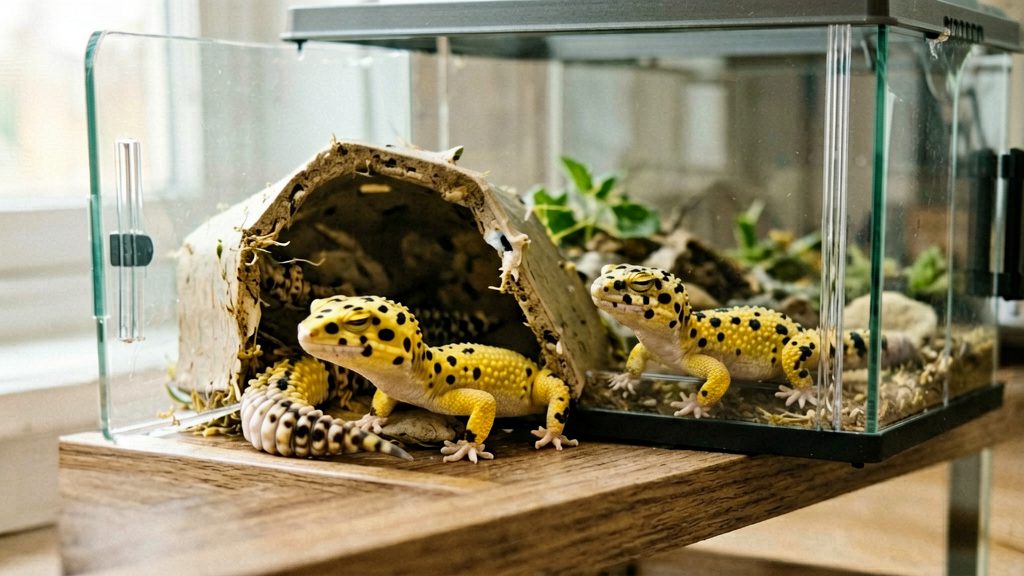
What should you watch for during shedding?
Skin may become dull before a shed, and leopard geckos commonly eat the skin they remove. Check afterward for remaining skin around the toes and eyes. Tight retained skin can damage toes.
Do not pull attached skin away: doing so can injure the new skin beneath it. If material remains caught, contact a reptile veterinarian for advice instead of attempting forceful removal. RSPCA
What cleaning routine should you establish?
Inspect the enclosure daily and remove feces, contaminated flooring, dead insects, and other waste. Clean soiled hard surfaces and furnishings when needed. A gecko may repeatedly use a particular corner, but inspect the whole habitat rather than checking only that spot. Manufacturer’s maintenance guidance
For more thorough cleaning, follow the reptile-safe disinfectant’s label for dilution, contact time, and rinsing. Let cleaned equipment dry before returning it to service. The RSPCA recommends rinsing and drying thoroughly after disinfection. RSPCA
How do you protect household hygiene?
Healthy-looking geckos can carry Salmonella. The CDC’s guidance, updated January 9, 2026, recommends washing hands with soap and water after handling the animal, feeders, droppings, or enclosure equipment, and before eating or drinking. CDC (2026)
Keep the gecko and its supplies away from places where people prepare, store, serve, or eat food. Supervise time outside the enclosure rather than allowing free roaming.
Clean habitat supplies outdoors when possible. If indoor cleaning is necessary, use a laundry sink or bathtub and clean and disinfect the area afterward; never use the kitchen sink. Pour enclosure wastewater into the toilet.
Children younger than 5 should not touch reptiles or their environments. The CDC also advises that reptiles are not recommended for adults 65 and older or people with weakened immune systems. Account for everyone living in the home when deciding whether this pet is suitable. CDC (2026)
Frequently asked questions
How long a commitment is a leopard gecko?
Ontario Reptile Rescue estimates an average lifespan of 15–20 years. Individual longevity varies, so arrange care with a long-term commitment in mind. Ontario Reptile Rescue
Can leopard geckos climb smooth glass?
They lack the adhesive toe pads used by many other geckos to climb smooth walls. Their claws still allow them to climb suitable textured furnishings. Manufacturer’s species description
Do I need to induce winter brumation?
No. A pet leopard gecko can remain on an appropriate year-round care regime without deliberate breeding-related cooling. Manufacturer’s seasonal husbandry guidance