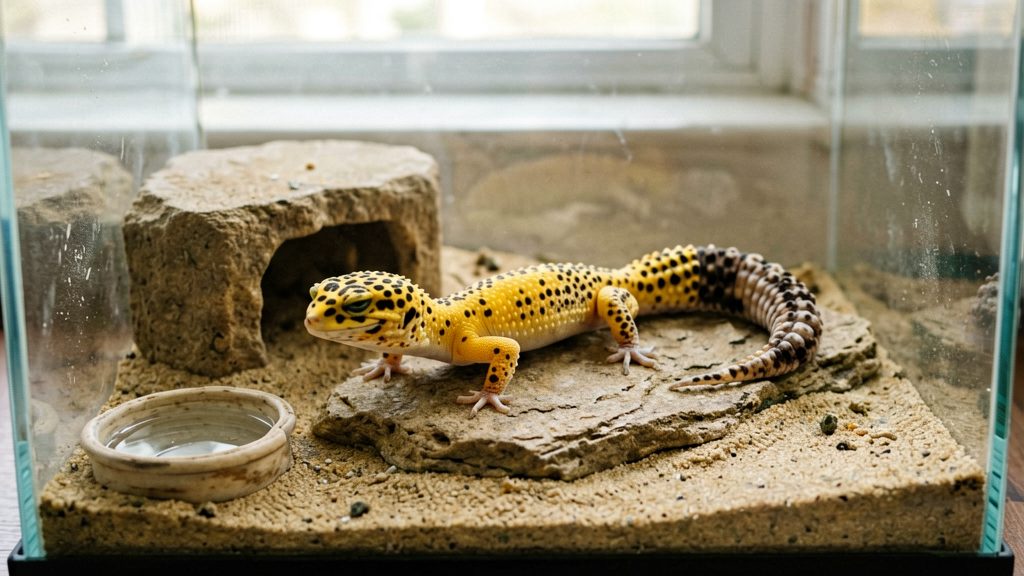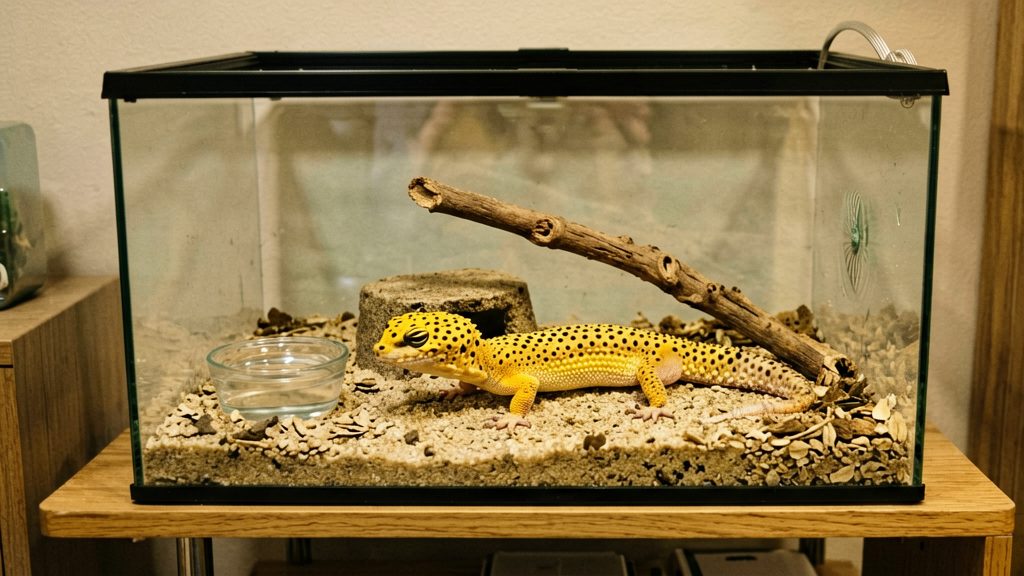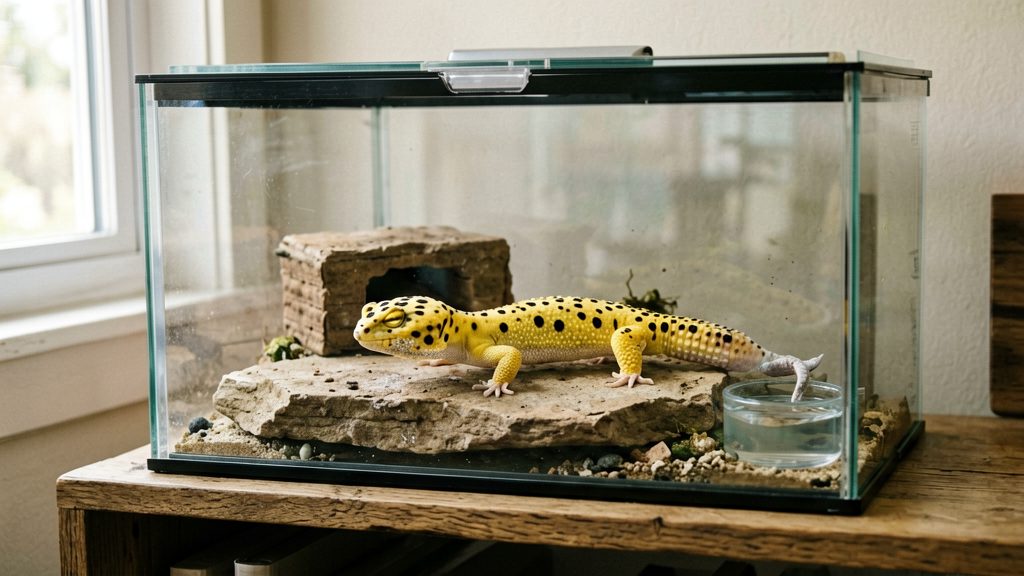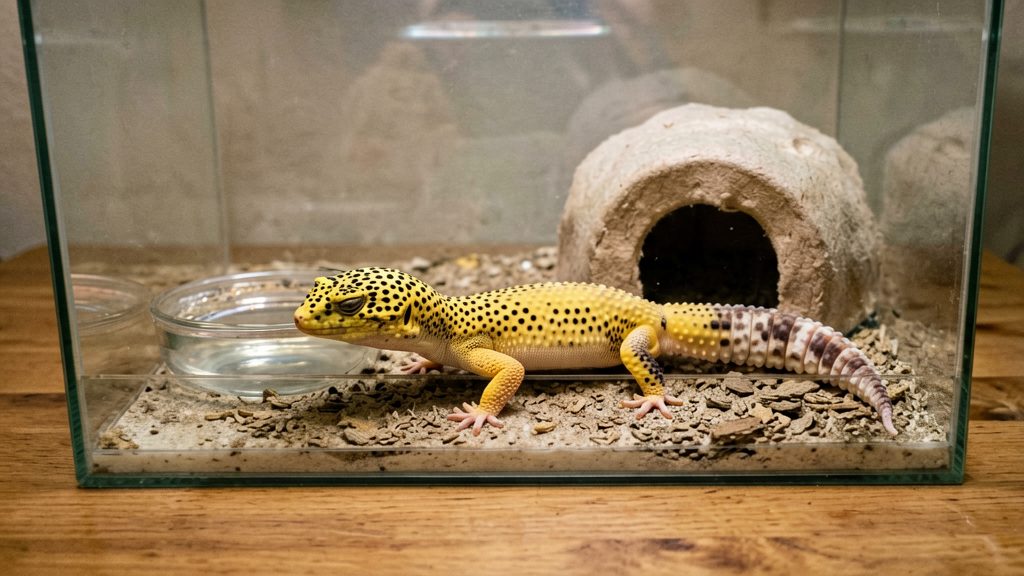
A first leopard gecko tank within this budget is possible only conditionally: suitable equipment you already own or receive must cover enough of the setup to keep the remaining purchases within your limit. Do not assume you can buy everything new within it. The practical approach is to inspect the available equipment, identify every missing essential, and postpone getting the gecko if the complete setup exceeds your budget.
What must already be available for this budget to work?
A donated enclosure can make a substantial difference, but an empty tank does not provide a controlled habitat. Before accepting equipment, ask for its model information, instructions, and operating history. Treat an unidentified electrical accessory as something to investigate rather than something ready to use.
Use this inventory to decide whether your project is ready for a shopping list:
| Equipment group | What must be accounted for |
|---|---|
| Enclosure | Suitable tank, secure ventilated lid or doors, and reliable closures |
| Heating | Heat source, compatible fixture, mounting hardware, and temperature controller |
| Monitoring | Independent temperature measurements and a humidity gauge |
| Lighting | Suitable UVB lamp, matching fixture, and a way to manage its schedule |
| Interior | Shelters, floor covering, and a drinking dish |
| Maintenance | Cleaning supplies and replacement consumables |
There are different starting situations:
- You already have a working, suitable enclosure and electrical equipment: the remaining purchases may be limited to basic interior supplies.
- You have only a bare tank: first establish the total for the missing equipment before buying decorations.
- You have no equipment: arrange suitable donations or save toward the complete setup before acquiring the animal.
Compare the actual checkout total with your spending limit, including shipping, sales tax, and replacement parts. A used fixture that needs a socket or mounting bracket belongs in that calculation. Keep the animal’s acquisition and continuing care expenses separate so they do not disappear inside the enclosure budget.
How do you choose an enclosure worth reusing?
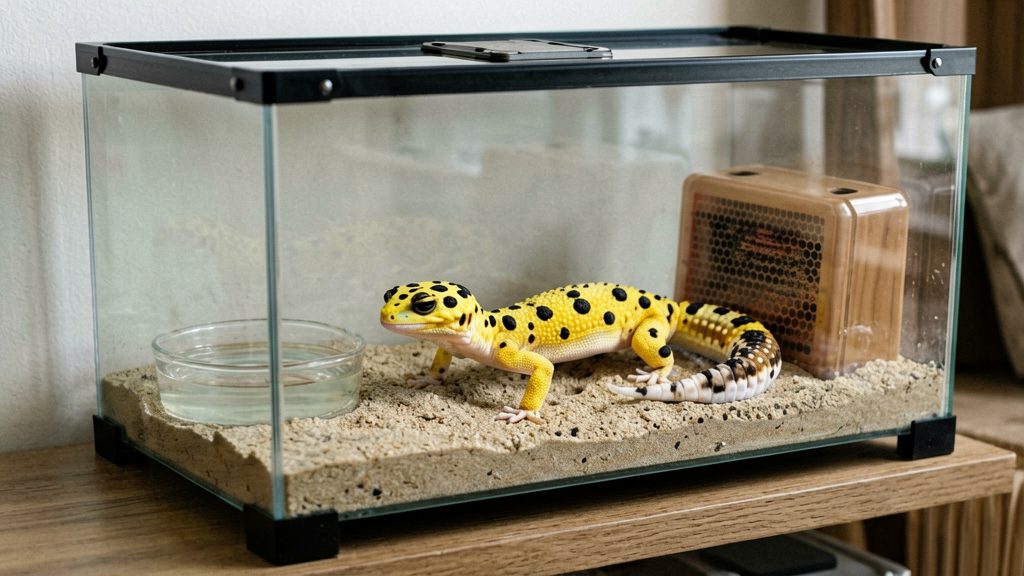
For an adult, a useful planning size is 36 inches long × 18 inches wide × 18 inches high, matching Mariah Healey’s published enclosure recommendation. This is a husbandry recommendation, not a nationwide US legal minimum. Recommendations differ, so do not treat the smallest tank mentioned in a care guide as an agreed standard.
Measure the usable interior rather than relying only on a gallon label. Floor space must accommodate the habitat without forcing the gecko to squeeze between furnishings. A tall, narrow enclosure cannot substitute directly for a broad footprint.
Inspect a secondhand enclosure before bringing it into service:
- Check glass, seams, frames, and door tracks for damage.
- Confirm that ventilation panels are intact and securely attached.
- Close every door and lid, checking their locks or clips.
- Look for cable openings that could become escape routes.
- Confirm that you can reach the interior for maintenance.
Position the enclosure on a stable support that meets its manufacturer’s requirements. Keep it away from direct sunlight and household heat sources that could change its temperature, as advised in the RSPCA’s enclosure guidance.
How should you install and measure the heating?
Place the heat source toward an end of the enclosure to create a warm-to-cool gradient. This lets the gecko move between conditions rather than remaining at a uniform temperature. An overhead daytime heat lamp is a practical starting option, provided its fixture, mounting position, and controller are compatible.
Choose the controller for the heating device. A dimming thermostat varies power to a compatible dimmable source. A manual dimmer requires human adjustment; it does not automatically respond to a temperature probe. Follow the thermostat manufacturer’s instructions for installation and probe placement, because the correct arrangement depends on the equipment.
For a clearly separated set of reference values, Healey’s current heating guidance recommends:
| Location | Recommended temperature | Measurement to distinguish |
|---|---|---|
| Basking surface | 94–97°F | Temperature of the heated surface |
| Warm hide | 90–92°F | Temperature inside the shelter |
| Cool end | 70–77°F | Conditions away from the heat source |
These are recommendations from that guide, rather than universal settings for every thermostat. A thermostat controls conditions where its sensor sits; its displayed setting does not establish the temperature elsewhere.
Use an infrared thermometer to check exposed surfaces and an independent digital probe thermometer to assess conditions inside a hide or in the air. Do not compare a surface reading with an air-temperature target. Keep the gecko from contacting the hot lamp, and observe the fixture’s mounting and clearance instructions.
Why does UVB need its own installation plan?
Leopard geckos can benefit from UVB exposure, according to manufacturer husbandry guidance. A visible-light lamp does not automatically provide UVB, and a heat lamp does not automatically replace a dedicated UVB source.
Select a lamp-and-fixture combination with instructions applicable to leopard geckos. Check the recommended distance from the animal, accounting for any raised furnishing it can reach. The percentage printed on a bulb is not a measurement of the exposure reaching your gecko.
Follow the manufacturer’s UVB installation guidance: ordinary glass and most plastics block UVB, while mesh reduces it by an amount that depends on the screen. A lamp above a glass lid therefore cannot be treated like the same lamp above suitable mesh.
Provide shaded retreat areas so the animal can leave the light. If the lamp’s instructions do not explain an arrangement matching your enclosure, ask the manufacturer before installing it.
Maintain a defined daytime lighting period followed by darkness. A 12-hour light period followed by 12 hours of darkness is an all-year schedule described in this manufacturer’s leopard gecko guide.
Build a simple floor, shelter system, and drinking area
Start with an easily inspected floor
Plain paper towels are a practical initial floor covering. They make waste visible and allow soiled sections to be removed without dismantling the habitat. Reptile & Rescue’s care guidance describes paper towels as a useful starting substrate while acknowledging their limitation: they do not provide digging opportunities.
Lay the covering flat and inspect it for damage. If the gecko tears or attempts to eat it, change the arrangement and seek advice on a suitable alternative. Treat an initial observation floor as a starting stage rather than a complete lifelong enrichment plan.
Give shelters different functions
Provide dry shelter in the warm area and another in the cooler area, plus a humid retreat. The Minnesota Herpetological Society describes this shelter arrangement in its captive-care guidance.
Simple washable shelters can serve these functions without decorative finishes. Any repurposed container needs a smooth entrance, adequate internal space, and a stable position. Reject sharp edges, narrow openings, and anything that can collapse or trap the animal.
For the humid retreat, use a waterproof-bottomed hide with a moisture-retaining lining kept damp rather than waterlogged. Keep the lining contained and replace it if dirty or damaged. The retreat provides a local moisture option; it does not require saturating the entire floor.
The RSPCA recommends roughly 30–40% humidity, measured at the cool end, alongside access to a humid hide. Use a hygrometer rather than judging humidity from appearance.
Add accessible drinking water
Provide clean, fresh drinking water continuously, as specified in manufacturer care guidance. Choose a stable, shallow dish with an accessible edge and an easy exit. Position it where the gecko can approach without climbing over unstable furnishings.
When is the finished tank ready for your gecko?
Run the completed enclosure empty through its programmed daytime and nighttime operation. Test it in the room where it will stay, with the final furnishings installed. An empty glass box and a furnished habitat can behave differently under the same heating equipment.
Record where each reading was taken, whether it measured air or a surface, and the room conditions at the time. This makes adjustments traceable. Change a setting or installation detail, allow conditions to settle, and measure again rather than changing several things simultaneously.
Also test normal operation after a brief power interruption, following the equipment instructions. Confirm that timers and controllers resume the intended schedule. Check that sensors remain secure when you open doors or remove a shelter for maintenance.
If conditions drift, investigate the cause before introducing the gecko. A successful test requires stable operation with the complete arrangement, rather than a favorable reading taken immediately after switching everything on.
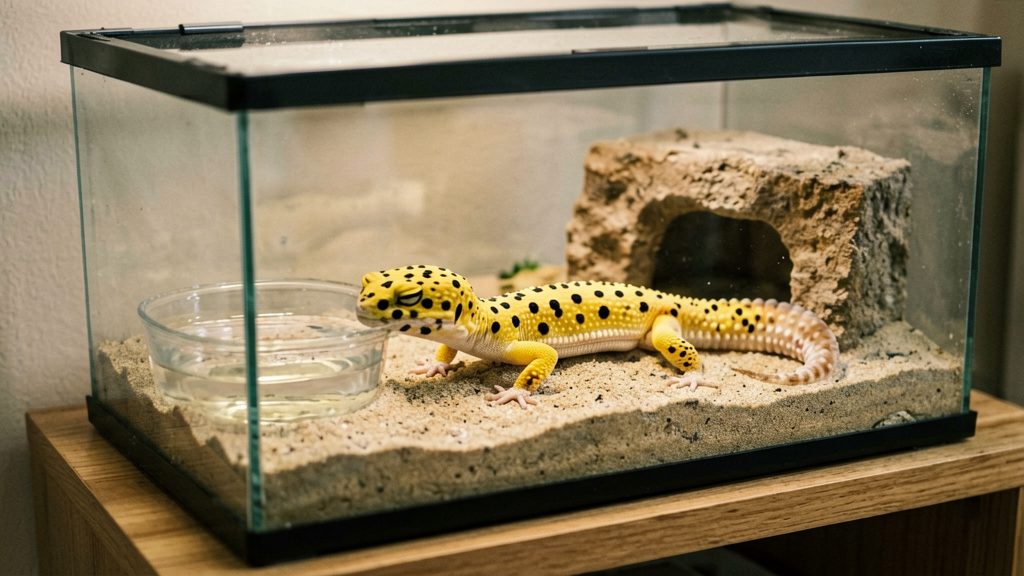
Clean reused equipment before it enters service
Separate cleaning from disinfection. Cleaning removes dirt; disinfection targets germs. According to CDC guidance updated in February 2026, hard pet supplies should be cleaned first when required, and disinfectants must be used according to their labels.
Choose a product appropriate for the material and intended use. Observe its dilution, contact time, rinsing, ventilation, and drying directions. Do not mix cleaning chemicals. Keep the animal away from the work area and return equipment only when the process is complete and the items are safe for use.
The CDC’s reptile guidance, updated in January 2026, recommends cleaning habitat supplies outdoors when possible, away from food and drinking-water sources. Indoors, use a laundry sink or bathtub and clean the area afterward. Wash your hands after handling habitat equipment.
Keep continuing care outside the setup calculation
A finished enclosure still needs supplies and attention. Leopard geckos eat insects, so plan for a varied feeder supply and suitable supplements. Follow the manufacturer’s feeding guidance and supplement labels; remove uneaten crickets after feeding. Ask the gecko’s current keeper for its feeding history so you can plan an appropriate routine.
Include electricity, replacement lamps, floor-covering replacements, feeder care, and access to a reptile veterinarian in your continuing budget. Record the installation date of each UVB lamp and follow its manufacturer’s replacement instructions.
Build maintenance into your daily routine: remove waste and soiled material, clean the drinking dish, and check equipment operation. This manufacturer care guide includes those tasks in its daily schedule. A manageable enclosure is one you can keep functioning consistently after the initial setup is finished.
Frequently asked questions
Can leopard geckos share a tank to reduce equipment needs?
For a first setup, house the gecko individually. Mariah Healey’s enclosure guidance advises against cohabitation because aggression and injuries can occur, including between females.
Can an electric heat rock replace the heating system?
Avoid electric heat rocks. Healey’s heating guidance warns that they can burn a gecko. They are different from an ordinary unpowered stone warmed by an external lamp.
Is a leopard gecko suitable for a household with young children?
The CDC recommends considering another pet for households with young children or people with weakened immune systems. Reptiles and their habitat equipment can carry Salmonella even when they appear clean.